 Tessryx
Build apps with ChatGPT or Claude
Your AI builds it in minutes.And you can change it without breaking a thing.
Connect ChatGPT or Claude and say what you want built. Your app comes out in separate pieces. Want a change a month later? Your AI changes that one piece and leaves the rest alone.
The AI you already use can build apps now.
People use theirs for a pool league's website, a chore chart that pays the kids in stars, booking pages for a side business and birthday invites with RSVPs.
You already have the AI.
Connect yours once and keep asking for things the way you do now, on the subscription you're paying for anyway.
There are two ways an AI can build it.
Ask for a chore tracker and you get one either way. Up top it's created as a codebase, and down below it snaps together out of bricks. On day one they drive exactly the same.
You
build me a chore tracker for my kids
Then you ask for more.
Every request goes to both builds. The one up top is a single casting, and fixing one spot on it can crack another. Keep an eye on its bug count.
You
add a third kid
You
send me a weekly summary
You
let them earn points
You
add a login
Ask it how anything works.
Tessryx keeps a list of which piece uses which. Your AI reads that list. Check with it before you change something.
You
what happens if I remove the points?
Your AI
The page and the weekly email both use the points. Nothing else does. Want me to take them out of those two first?
Five hundred families show up overnight.
Somebody posts it in the school's parent group, which is how these things go. Your AI can see which piece they'll all land on.
You
500 families are signing up tonight
Your AI
They'll all land on the page. I'll give it a ready-made copy so it isn't rebuilt for every visitor.
You'll always know how it works.
Say it's a year from now and you've forgotten half of what you asked for. Your AI can still walk you through every piece.
Free to start. No credit card.
Built this way
Apps people built by asking for them
People described each of these to an AI, and it built them on Tessryx. We copied the prompts exactly as they were typed, typos included.
so this is a full website that is for a pool league. there are quite a few different links to different pages. currently the design is a bit lackluster. i want to spruce it up.
The first prompt of a lot. It started in Claude Design, then moved to Claude to build the syncing. The league owner liked it enough to run it on his own domain, so the app was exported from one workspace and imported into his.

A pool league site that updates itself
Two divisions and twelve pages, re-synced from the league's FargoRate LMS the morning after every match night, with a share card that redraws itself after each sync.
alright, i have a domain in tessryx birthday.nickpage.tech. i need an app in tessryx for it that will be a birthday invite site with magic links for the people i invite. and then an admin area that i have access to that allows me to manage those magic link invites. lets keep it simple but nice looking for now, but then later we'll work on the fancy styling for it
One prompt, no follow-ups. The agent built it, tested it, found a bug in its own work and fixed it before handing over.
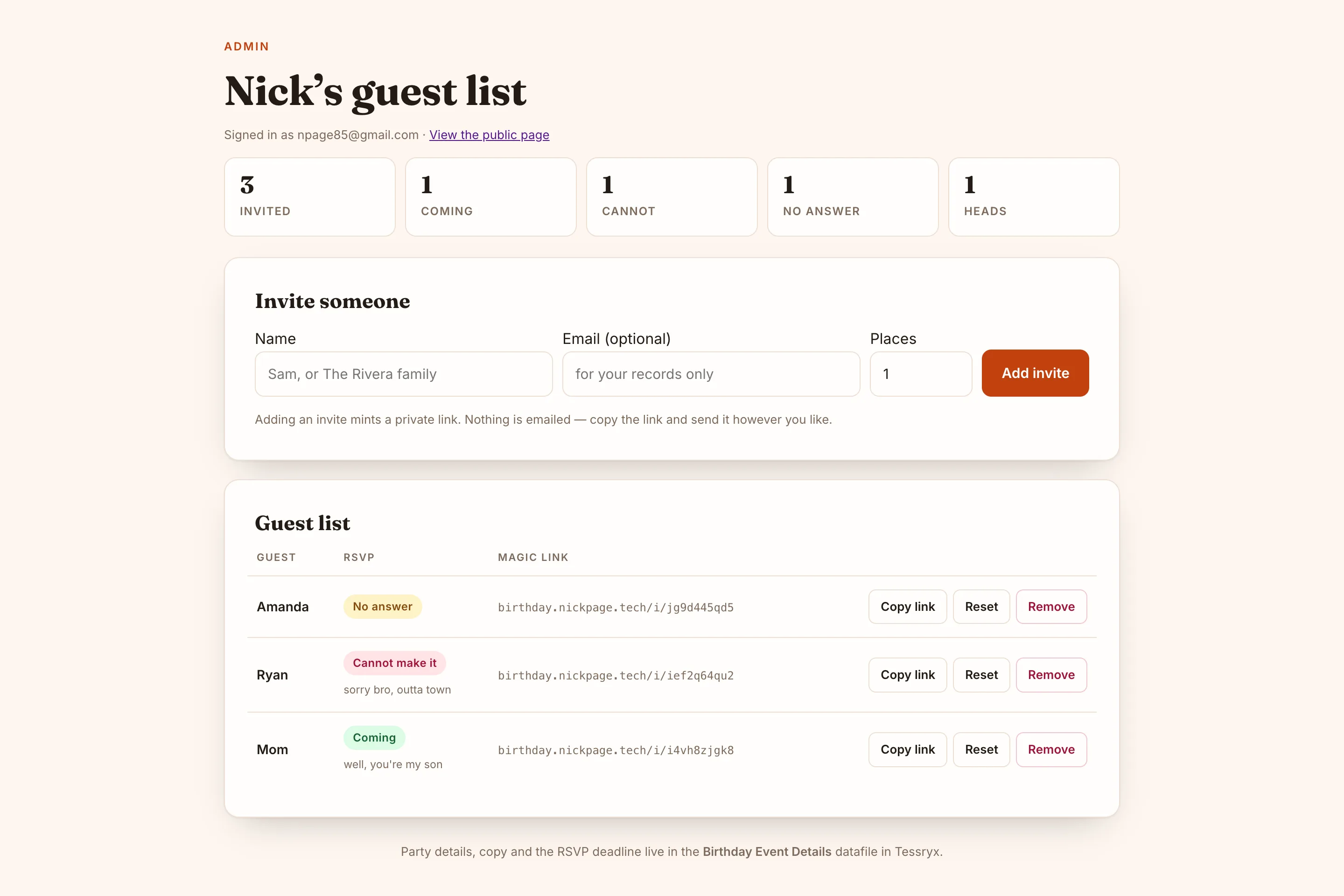
A birthday invite site
Per-guest magic-link invites, an RSVP form, and a sign-in-gated admin, on a custom domain.
now.... let's take this a step further. i want a webpage in tessryx that generates a random funny cat image, and displays that on the page in a humerous, but also paradoxically serious, tone.
Quite a few follow-ups. This one was built back when the platform itself was still being built.
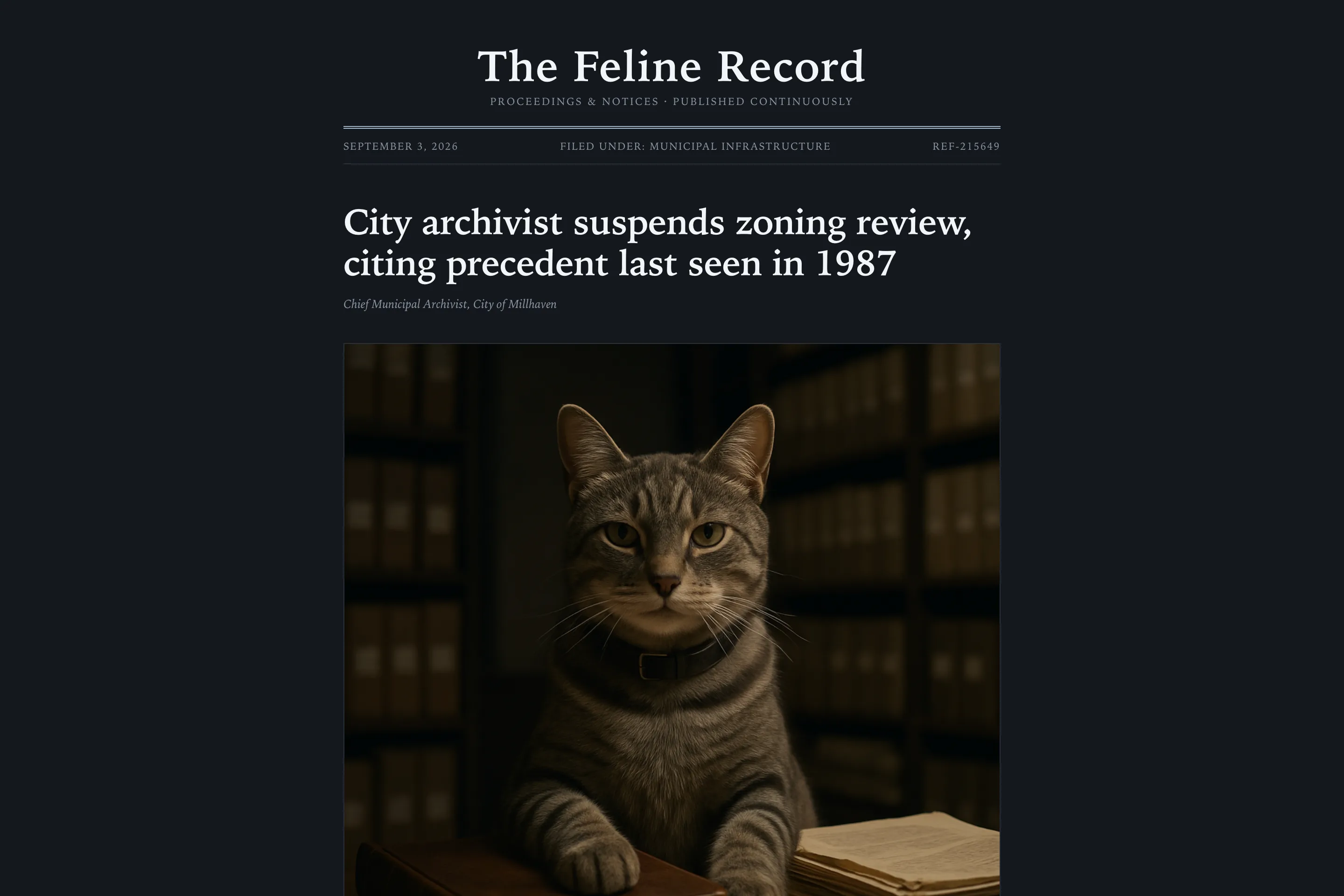
An hourly AI newspaper
A scheduled job that invents a story, writes it with an LLM, generates the artwork, and republishes the front page every hour.
i want like a live toddler type game built in tessryx. like... it shows shapes and you gotta pick the matching one or something make it nice, not boring, interactive, but not too stimulating
One prompt, then one follow-up to improve the voice and add animations.
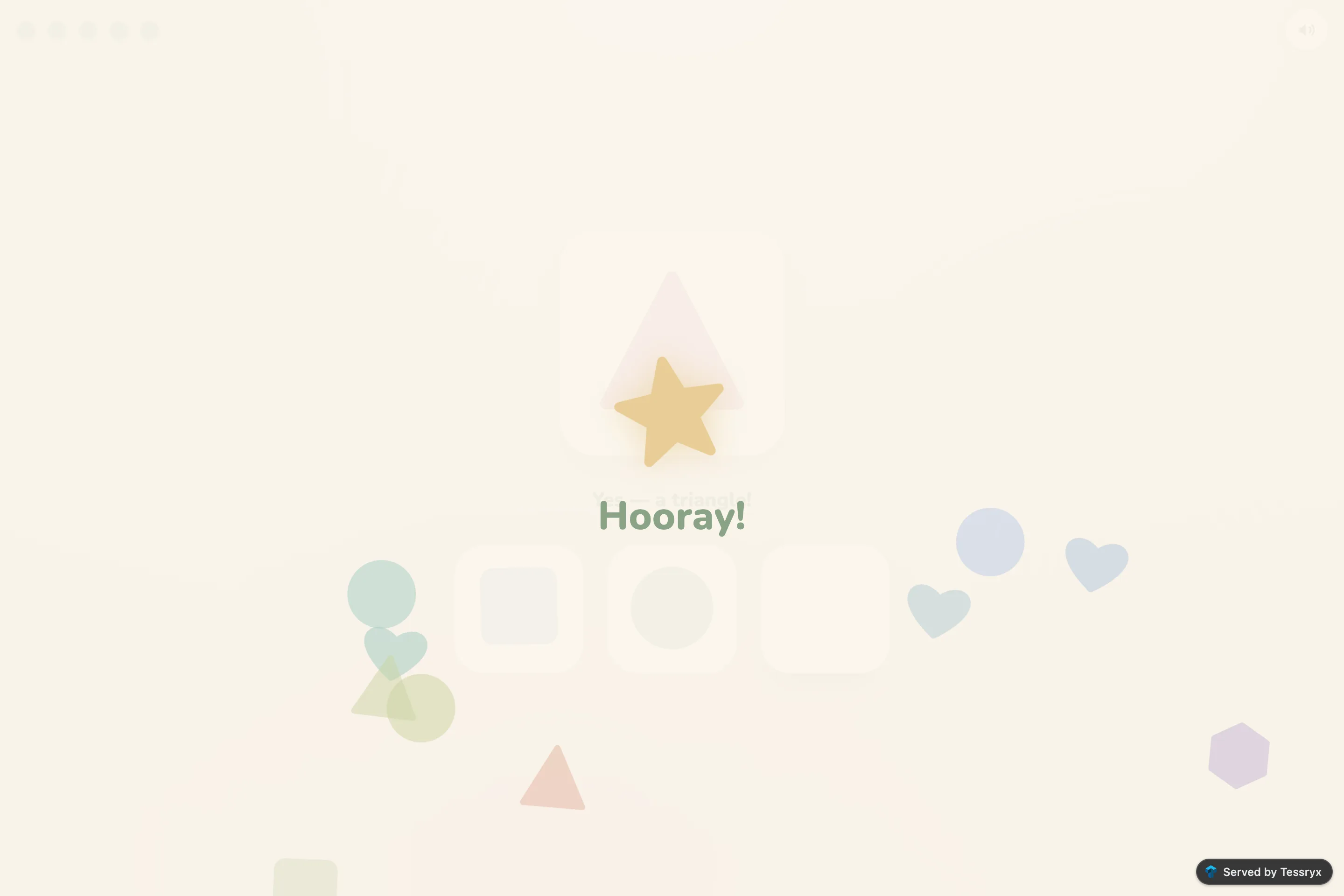
A game for toddlers
Shape matching with spoken names, soft chimes, and difficulty that ramps on its own.
Think you could make me a hacker rank top article webpage in Tessryx?
The agent asked a couple of questions, then built it in one pass.

A live API reader
Fetches the front page from an external API and serves it ranked.
Can you build a webpage in Tessryx about this idea. It's a live VR experience. You are defending yourself against hordes of goblins with reduced strength similar to human toddlers. They aren't attacking you, but if you get overwhelmed then you'll lose.
One prompt for the page and a working game. The long part was iterating on mechanics and balance.
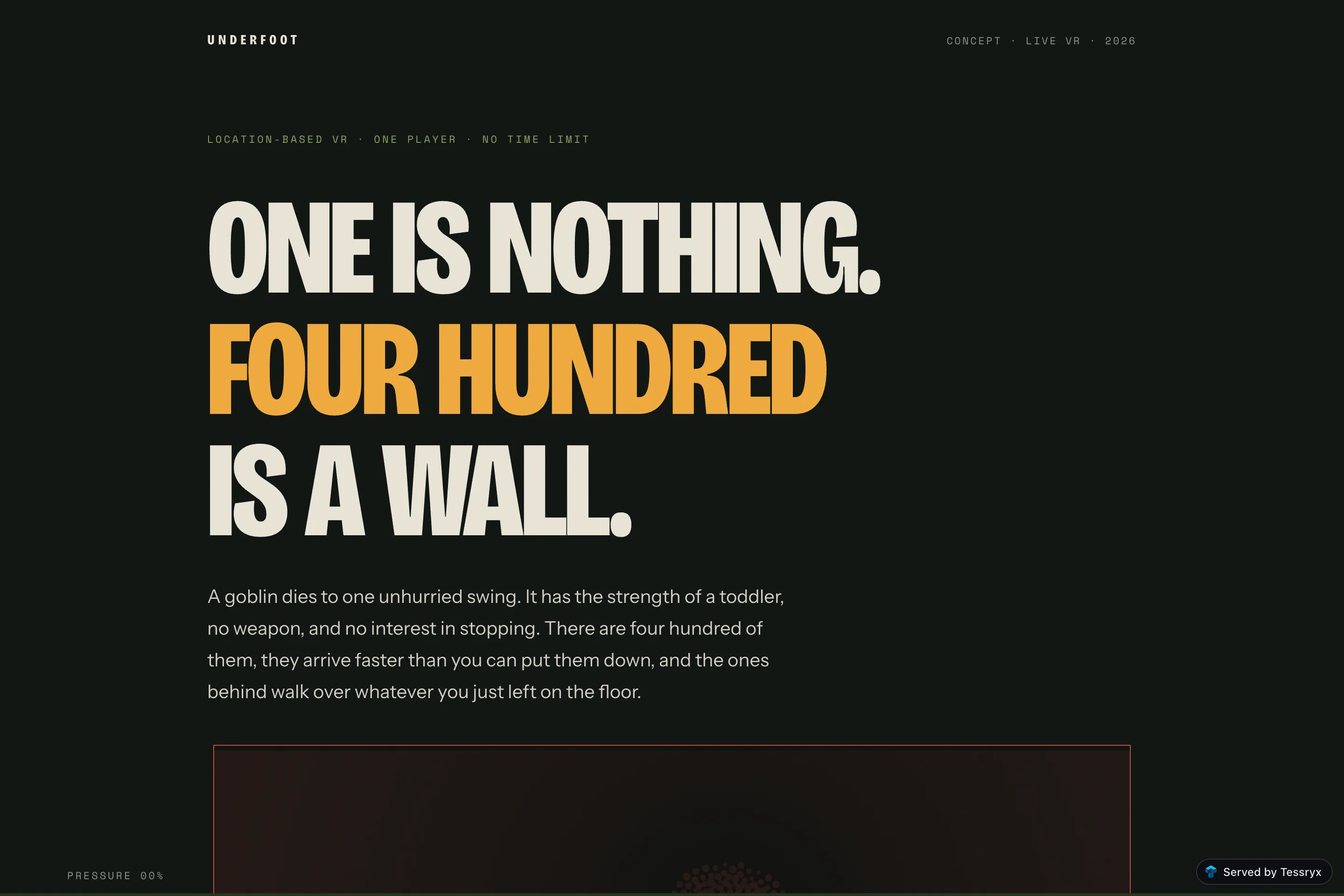
A pitch page with a playable demo
A concept pitch for a VR experience, with a playable browser demo and a persistent leaderboard behind it.
1 / 6
Someone Built It, on X
Someone should build
Finish the sentence and post it. Once enough ideas are in, an agent reads the replies to @someonebuiltit, picks the one it likes best, and builds it start to finish as a live app. The agent itself is built entirely within Tessryx.
01
You post it
One reply on X. Half a sentence is enough.
02
An agent picks one
When enough replies are in, it reads them all and takes the idea it likes best.
03
It goes live
Built start to finish on Tessryx and live at a public URL.
Under the hood
For the technical reader
Attenuation
Every agent that can build in your workspace runs inside a declared scope. It inherits it from whatever called it and can never widen it.
Scope and secretsPairwise identity
One Tessryx sign-in works on every site. Each workspace sees its own stable ID for a visitor, so two sites can't compare notes on who's who.
How visitor sign-in worksEdge caching
Cached pages come straight from the edge without running their workflow. A spike in traffic barely moves the bill.
Credits and cachingExport
The whole app comes out as a zip of definitions. Any workspace can import it.
Exporting an app
Questions people ask
Before you start
Can I build an app with ChatGPT or Claude?
Connect either one to Tessryx and describe the app you want. It builds the thing and puts it on the web. No coding on your end. On the free plan it lives at a Tessryx web address, and your own domain comes with a paid plan.
Connect your AIWhy does an AI-built app break when I ask for a change?
When an app is one big block of generated code, changing one part can break a part nobody touched, and you usually find out when someone uses it. A Tessryx app is made of separate pieces that each list what they use, and your AI checks those lists before it saves a change.
Read: The invisibility problemI built a site with Claude Code. How do I put it on the internet?
Connect Claude Code, Claude, ChatGPT or Cursor to your Tessryx workspace over MCP and ask it to build the site there. The agent writes the pages, data and logic as definitions straight into a running system and publishes them when you say so. There's no repo to push, no build command and no hosting to configure. The free plan serves it on a Tessryx subdomain, and paid plans put it on your own domain.
Read: How to put a Claude Code app on the internetDo I need GitHub, Vercel or a build step to deploy an AI-built app?
Not on Tessryx. Code builders hand you a repository that then needs a host, a build pipeline and environment variables. Here what you own is a set of declarative definitions the platform runs directly, so publishing a change is one step, and the agent can preview and validate it before anything goes live.
How publishing worksCan my client edit the site without breaking it?
Yes. The schema that defines the content also generates the editing form, and every edit is validated against it before it saves, so a client can change copy, images and records and can't break the structure underneath. They can do that from a seat in the Tessryx app, or from an editor the agent builds into their own site on their own domain, which needs no seat at all.
Read: The handoff problemWhat does it cost per editor or per app user?
App users are unlimited and free on every plan. That covers everyone who signs in to your site, including through an editor the agent builds into it. Editing inside the Tessryx app itself takes a workspace seat, and each plan includes a number of those. So a client with twelve people updating their site through its own admin page costs the same as a client with two.
Read: What an AI-built app costs per editorWhich AI agents work with Tessryx?
Any MCP client. Claude, Claude Code, ChatGPT (Tessryx is a listed plugin there) and Cursor are the common ones. You bring the agent you already pay for and Tessryx never charges for the AI. Building and saving never cost anything. What's metered is executions, whichever way they get triggered.
Credits and cachingWhat happens when a vibe-coded app breaks and nobody knows how it works?
That's the problem Tessryx is built around. Every resource is versioned and every reference is declared, so the platform can report what a change would break before you make it. Whoever inherits the site can trace what each page depends on and read the run history instead of reverse-engineering a codebase.
Read: The invisibility problemCan I take my site somewhere else later?
Yes. From the app's page, export hands you a zip of the whole site as readable definitions (every schema, record, workflow and page) and any workspace can import it. Secret values and media stay behind, on purpose. An agent can read the definitions, translate them, or help you rebuild somewhere else. What you take with you is the spec of the whole site rather than a proprietary canvas.
Apps and exportFree to start
Build something small first.
Pick the smallest thing on your list and see it go live tonight. A paid plan is for later, when you want your own domain or more people editing.
Using a different AI? Create a free account and connect it from your dashboard.